two essays that went unexpectedly viral in the wake of the northern california firestorm of 2020
https://www.facebook.com/michael.tank/posts/10111080741741546
It breaks my heart to see the forests in the Bay Area and Northern California burning again. My father will likely lose his house. Many friends are evacuated. I and others are out of state in search of fresh air for compromised lungs.
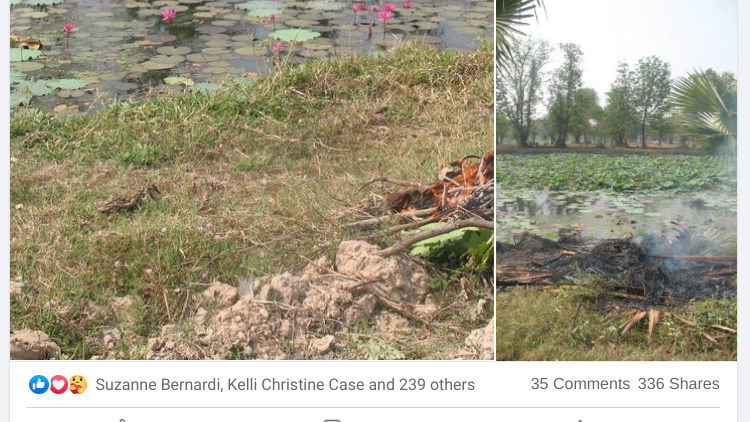
For those of you who are looking on at this disaster from the sidelines, I want to help you visualize what a mostly healthy, managed fire ecology looks like. This photo is Northern Thailand in 2012, where I spent a month in burn season. Notice the short grass and lack of ground fuels. The space between the trees in which livestock graze. The long views through the woods. The land tenders and monks setting bonfires and back-burns as a part of their seasonal chores. The unattended burn piles that are as common and mundane as the livestock. The slow burn lines on the hillsides. And yes, lotuses in the muck.
There are accounts of North America being like this in the colonial days – the one that comes to memory describes a forest so well managed that one could gallop a horse from New York to Chicago unencumbered. Some of our old-growth redwood forests have this quality of openness. Perhaps Big Basin will again for our children.
San Francisco lies not at the latitudes of London or Berlin – it shares more in common ecologically with Syria or Morocco. For those of us whose ancestors lived for centuries in the northern four-season climates, the skills and rhythms of a three-season fire ecology are foreign to our bones. The European settlers of California could never even begin to understand this tropical and Mediterranean phenomenon, and could not have seen what the indigenous peoples understood of the landscape after millennia tending it. California instead outlawed indigenous fire-tending practices. Government agencies have since managed the forests for timber or recreation – maximizing biomass instead of balancing ecology and fire risk. We can see the projection of these extractive and romantic ideals of Western ideology on the landscape, not only in the intrusions of wood-frame housing and power lines into the forests, but also in the untended thickets of manzanita and low-grade pine regrowth that you can see from almost any hike you might go on. Drive up into the woods almost anywhere in the American West and you’ll see this form of neglect.
When the fires come, I often see friends calling out for unseasonal rain for California – rain which will not come, or which will bring more lightning and more fires. This is magical thinking, and points to a learned helplessness. We cannot create rain, but we can reduce fuel.
When the immediate danger has passed, we must visualize and organize for California to become a thriving fire-tending society. Imagine herds of goats devouring blackberry and poison oak thickets. Learn to use a machete and a chainsaw. Petition the Governor to not only purchase more firefighting aircraft, but also hire indigenous leaders to help us undo the damage of the logger barons, and quit using prison labor to fight fires. Imagine and plan for sustainable, fire-defensible cities. Political coalitions between city and country that respect and enable the work that needs done to sustain the land. Economic support for ecological stewardship.
The apocalypse we are currently experiencing is the logical conclusion of our civilization. We must, instead, imagine something new and sustainable. We do not understand how it works yet, but some of us have the pieces. It is the only way.
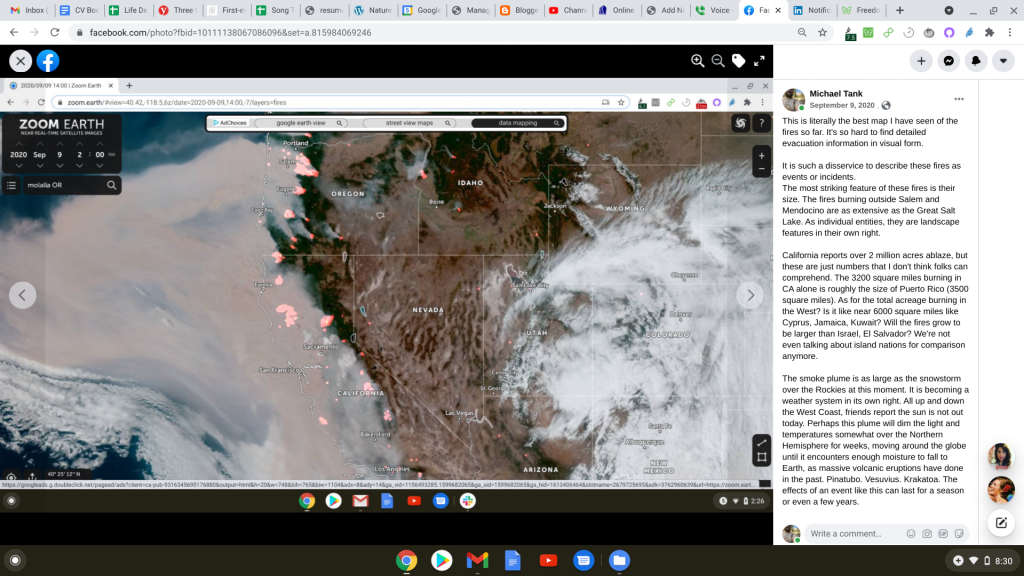
UPDATE: I’ve learned from my feed in tangent with writing this that there are currently multiple indigenous-led efforts that are engaging in this work. Here are some links about organizations like www.tekchico.org and TREX in Humboldt that are working toward reintegrating indigenous cultural knowledge in our fire policy and giving management of #LandBack: https://www.chicoer.com/…/we-are-helping-the…/…https://www.northcoastjournal.com/…/unleashi…/Content…
In the wake of the Australian firestorm last year, there have been similar organizing efforts through a group called the Firesticks Alliance: http://www.firesticks.org.au/
I encourage people to support these efforts in your region to reintegrate indigenous cultural knowledge into landscape stewardship – as I hope you can understand from my writing, it takes generations of trial and error to learn to live in harmony with a landscape, and that is something that the vast majority of Californians are generally not attuned for.
Additionally, Ecosystem Restoration Camps has had a hub in Paradise since the Camp Fire. This is a permaculture-based model that can be used to help in this and coming years: https://ecosystemrestorationcamps.org/camp-paradise/