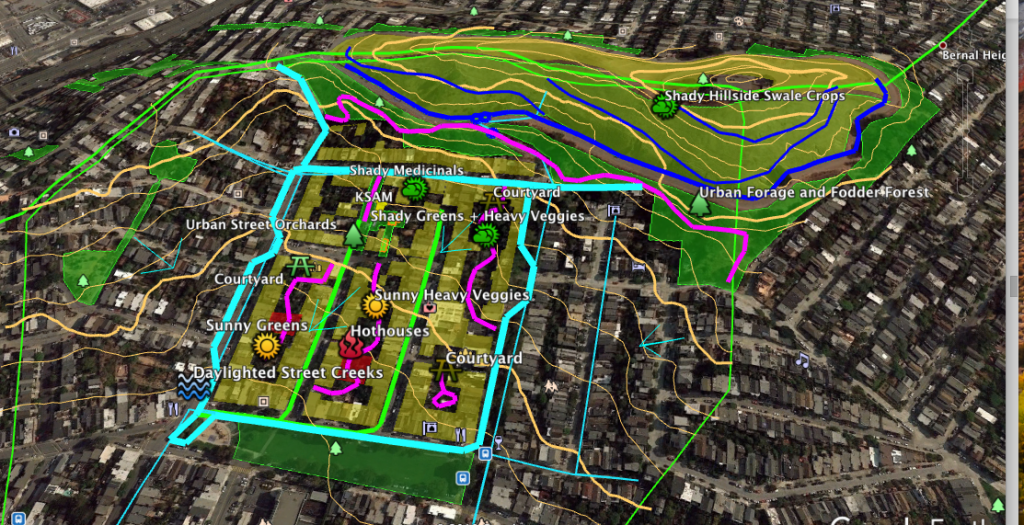
urban permaculture research and design proposal, google earth, 2019
The City of San Francisco produces a fraction of one percent of its food, water, and shelter needs from immediately local resources. This is the engineered reality of first-world cities of this sort of density (an average of about 17,000 residents per square mile). San Francisco as a metropolitan area is divorced from its productive hinterland by its suburbs, but also by its geographic features – bays, mountains, and the ocean. It’s closest major agricultural region is the Sonoma area – 40 miles away. The 8+ million person metro area extends and sprawls 60-70 miles in some directions, and there is not enough flat and arable land within 100 miles to produce 100% of the food for our population using conventional methods.
In addition, the water supply for the vast majority of the Bay Area comes from reservoirs and watersheds nearly 150 miles away in the Sierra Nevada. Sufficient rainfall comes in an average year over the surface of the populated area in order to quench the thirst of all urban water needs, yet there is nearly zero man-made infrastructure in place to capture and purify such a vast water supply.
This support structure has worked for the last one hundred years, but it will be challenged within the next hundred. Climate change promises to be relatively gentle to the California coast – but our inland areas, upon which we depend for agriculture, will change drastically. Bakersfield may become more like Phoenix, AZ (too hot and arid for agriculture) and our further south deserts uninhabitable. Southern California may find it more challenging to have an export agriculture in the future. In such a context as this, a regional permaculture can serve as a disaster preparedness plan rather than a personal self-sufficiency plan.
San Francisco is blessed to have ⅙ of its landmass devoted to public green space, and another ⅙ divided into private yards. In our Bernal Heights neighborhood – a typical low-density residential neighborhood – we have about 3 acres of private space for 400 residents. I estimate that we could grow up to 10-12% of our food needs on such land if it were intensely cultivated, or roughly a third of our vegetable and fruit diet. I began this report hoping for 50% (a rich vegetable diet) but it simply is not possible given the current land available. This number could grow to half our vegetable and fruit diet if we also turned some (but not all) of the public lands for production.
the north bernal urban ecovillage plan is a theoretical ten-year plan that defines steps towards creating a resilient neighborhood. This would be the nature of the shift in our urban fabric which would produce such an efficiency of food production that could sustain a neighborhood through a disaster which makes its productive hinterland temporarily inaccessible.